
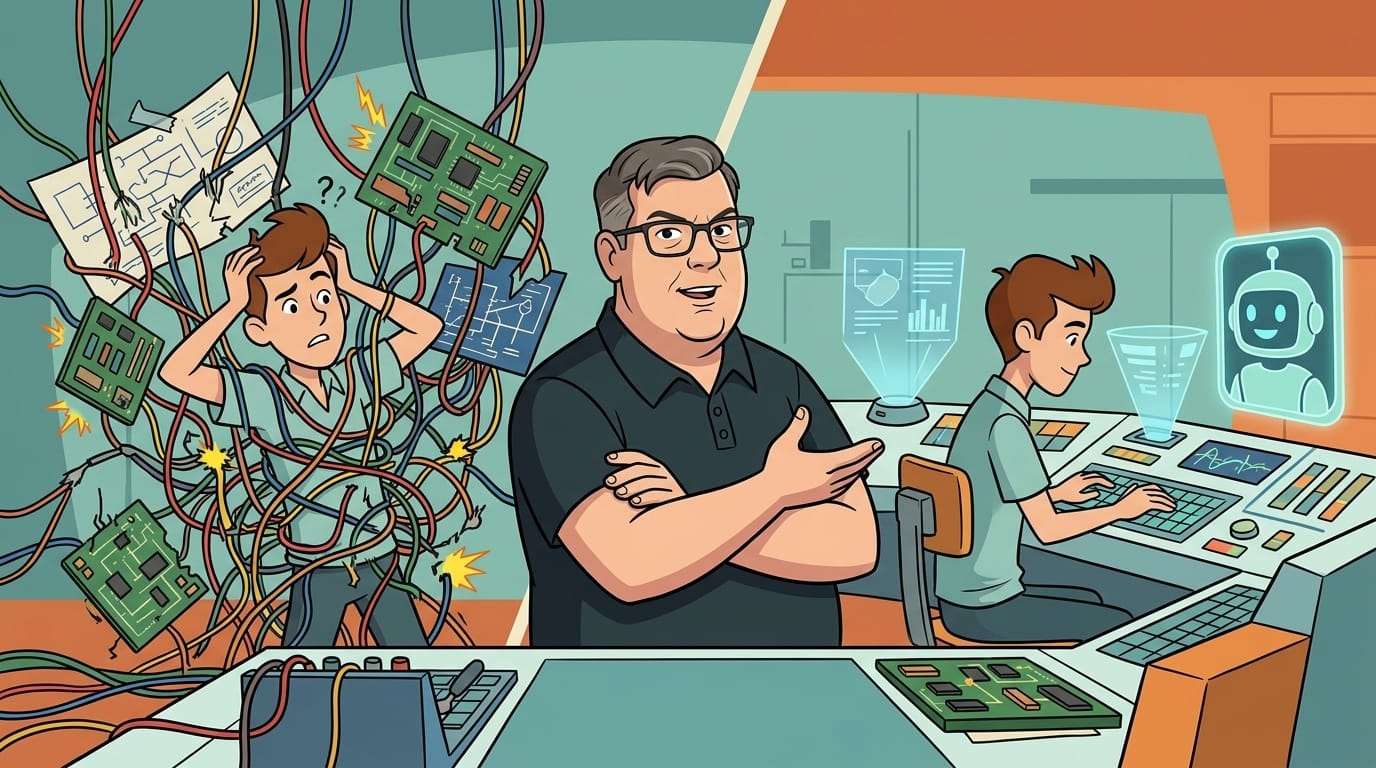
Last Friday, Linus and Luke titled the WAN Show "Software Is Over." They were half-joking. The story underneath it should bother every software executive more than it apparently does. In the span of a few weeks, two different people rebuilt Photoshop. Separately. Neither one knew the other was doing it.
One is a developer at Tenzen Studio who shipped Photon Studio, a free, offline desktop image editor with layers, masks, curves, and PSD support. He built it by vibe-coding: he ran a deep-research pass on Photoshop's feature set, fed it to GPT-6 Astra to draft a plan, then looped, use the app, find the bugs, send fixes back to the model, across extended sessions. By his own account on r/vibecoding, the tokens cost him about $2,000 (Gadget Review).
The other is Brandon Thomas, an Atlanta engineer with a decade of Rust behind him, who rebuilt seven of Adobe's flagship apps, Photoshop, Illustrator, Premiere, Lightroom, Acrobat, After Effects, and InDesign, in Rust with Claude Opus 5.5, and dumped them on GitHub free and open-source under the name Artcraft (Ars Technica). His Photoshop clone cleared tens of thousands of stars in days.
Here's the number that matters. One person, working alone with an AI, produced a usable-in-places Photoshop for about the cost of a single year of a Creative Cloud subscription. And a second person, weeks later, with a different model, did the same category of thing on the same scale of effort.
One of those is a stunt. Two is a curve.
The Caveat Is the Argument
Let me be precise, because the honest version of this story is stronger than the hype version.
Neither of these is ready. The Tenzen developer called the early builds buggy and unstable (Gadget Review). Thomas told Hacker News his apps are early alpha, "not anywhere close to ready" (Gizmodo). Reviewers found real Photoshop muscle memory working next to features that undo themselves for no reason (Digital Trends). Adobe is not dead. The clones are not a drop-in replacement.
Thomas himself gloated that he'd "one-shotted Photoshop" and that software is over (Ars Technica). He's wrong, and the overreach is a tell. If you want the "software is over" post, this isn't it.
The alpha-state caveat isn't a weakness in the argument. It's the argument. The cost that matters isn't the cost of a finished, polished competitor. It's the cost of getting from nothing to people are running it. That number used to be a funded team and several fiscal quarters. Photon Studio got there for about two thousand dollars in tokens, and the fact that a second builder cleared the same bar weeks later with a different model tells you the first one wasn't a fluke. One cheap Photoshop is a curiosity. Two, independently, is a cost floor that moved.
The Fourth Variable, Again
I've made this argument before in a different domain. Government procurement spent thirty years choosing between build, buy, and rent, and the whole triangle rested on a hidden assumption: that the cost of production was a high, fixed floor. Collapse that floor and the model doesn't improve. It stops being a triangle.
The Photoshop clones are that same physics playing out in consumer software, in public, in weeks. The cost of turning a decision into working software is falling toward the price of the electricity. When the expensive part of building stops being expensive, every framework that treated it as expensive has to be rebuilt.
This is what the AI community means by personal software: software built to fit one purpose, for one context, without pretending to serve everyone. The gatekeeper was never the license fee. It was the cost of production. As long as building a real tool took a funded team and quarters of runway, software had to be general-purpose, because that was the only way to spread the cost of building it across enough customers to justify it. That is why you get catalogs of products that fit everyone a little and no one well.
Collapse the production cost and the reason for general-purpose software evaporates. The Tenzen developer didn't set out to serve a market. Thomas got charged a cancellation fee one too many times and built the thing he wanted (Amateur Photographer). The fact that tens of thousands of other people wanted the same thing is almost incidental.
What This Means If You Run an Enterprise
Stop reading this as a culture-war story about Adobe and start reading it as a cost curve.
For a generation, the hard, expensive, scarce thing was writing the code. Everything in how we staff, budget, and prioritize assumed that scarcity. Requirements were cheap and code was dear, so we rationed engineering and spent freely on meetings about what the engineering should do.
Flip the scarcity and the whole operating model is upside down. When production is cheap, the expensive thing is knowing what to build. The constraint moves from the keyboard to the problem definition. So the honest question for any leader watching this is: as the cost of production falls, are you redirecting those freed-up resources into understanding the problem better? Or are you just pocketing the savings and building the same under-specified things faster?
Three things deserve explicit investment, and most organizations fund none of them well.
Connect the people who own the problem with the people who can solve it. The person who feels the pain is rarely the person who can build the fix, and in most enterprises there are three layers of translation between them. Every layer loses fidelity. The lesson here is that the distance between problem and solution just got short enough for one person to close it. If your org still routes that distance through a six-month intake process, you're spending the one thing that got cheap on the one process that stayed slow.
Document the workflows. Actually document them. The reason off-the-shelf software never fits is that nobody wrote down how the work actually happens, so the vendor's guess becomes the de facto process. When production is cheap, the binding constraint on building software that fits your mission is an accurate description of your mission. That description is now your most valuable asset. Not the code. The code is downstream of it, and the code is cheap. The articulated, maintained, honest account of how your organization actually works is the thing that can't be vibe-coded.
Make those descriptions shared, governed, and protected. Cheap production without controls is a liability, not an asset. If anyone can spin up mission software in a weekend, you need the workflows, the data access patterns, and the guardrails to live somewhere central, with the right protections, so that forty people building forty tools aren't each inventing forty ways to leak the same data. The thing that scales isn't the code. It's the shared, governed description of the work the code is allowed to touch.
The Part Nobody's Pricing In
There's a second-order version of this that's more interesting than any single Adobe clone.
If one person can rebuild an image editor over a weekend, the same capability can build things that were never products because the market for them was exactly one person. The strange genre hybrid nobody would fund. The oddly specific internal tool that would never clear a product committee. The interface that only makes sense for how you think. Software stops being something you select from a catalog and starts being something you compose for a context, the way you'd write a memo instead of buying one.
The catalog model, pick the closest general-purpose product and bend your work to fit it, was a consequence of production being expensive. Remove the cost and the catalog loses its reason to exist for anything that isn't a genuine utility. Rent the plumbing. Compose the rest.
Watch the Price, Not the Lawsuit
Now watch the two sides move in opposite directions.
On the new side, the price of the result is already zero. Both of these editors shipped free. Not discounted, not freemium, free; because when a working tool costs one person a few thousand dollars in tokens to make, there's nothing to defend and no revenue model to protect. The going rate for a Photoshop-class editor, on the side of the market where AI did the building, is nothing.
On the old side, the incumbent is spending lawyers. Adobe closed this year with a $150 million settlement with the government over how hard it made subscriptions to cancel (Gizmodo). Set aside the merits. Look at the direction of effort. One side is racing the price of production to zero and giving away the result. The other is litigating over exit fees. That is what the end of a cost regime looks like: the new entrants can't give it away fast enough, and the incumbent is fighting over the cost of leaving. That fight only accelerates from here.
Adobe will survive this particular Friday. The point was never Adobe.
The point is that a floor everyone built on just gave way, and the people still standing on it don't feel the fall yet. That's the dangerous part. Not the collapse. The lag between the collapse and the moment the people on the old floor notice they're already falling.