
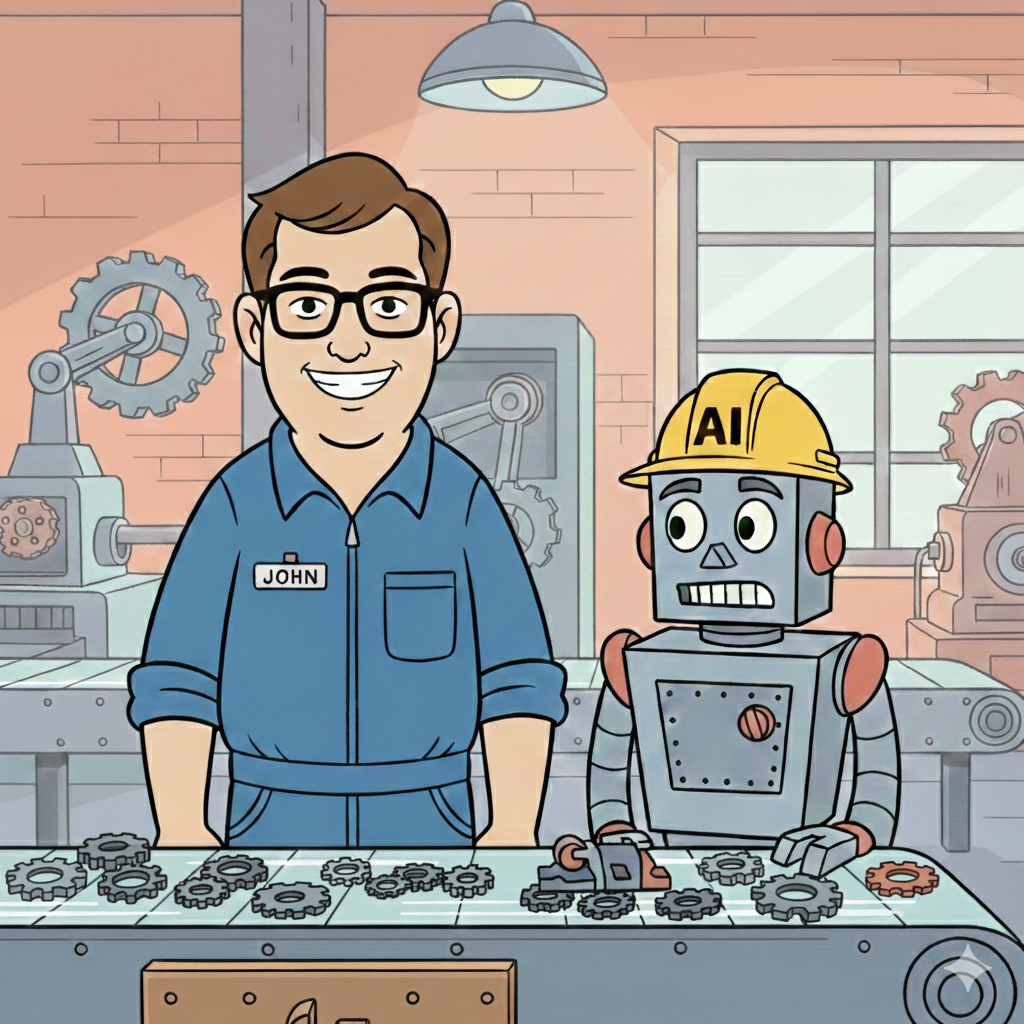
We love talking about AI in extremes; we focus on total disruption, mass unemployment, or the rise of robot overlords. We spend endless cycles on financing and existential risks, often overlooking the practical reality of how this technology actually shows up at work today.
To move from speculation to strategy, we need to understand the difference between AI in the workflow and AI on the workflow. They carry very different risk profiles and drivers, but both can be leveraged to accelerate outcomes.
What is a "Workflow"?
Before we dive in, let’s define workflow through the lens of a Value Stream, which is the journey from "need" to "fulfillment."
We often mistake workflows for a simple list of procedures to complete a single task. In reality, a workflow is the comprehensive set of actions required to meet a need. Shifting your perspective from "What do I do to finish this task?" to "What do I do to fulfill this need?" is an enlightening and necessary pivot.
AI In the Workflow: The Participant
When AI is in the workflow, it is integrated directly into the process; it is an active participant in completing tasks.
- Examples: Financial models deciding loan approvals, computer vision unlocking your phone, or fully autonomous agents handling customer service requests.
- The Risk: Whenever you change the fundamental procedure of a task, you increase risk. Much of today’s "AI drama" stems from entire workflows (every task between need and fulfillment) being disrupted simultaneously.
When software development moved slower, we had time for traditional change management. Today, with agentic workflows attempting to automate the entire chain, change risk is being piled up into unrealized risk. Sometimes, as we have seen, that results in a disaster. Successful "In the Workflow" implementations carefully analyze where technology changes the risk profile in favor of speed, rather than just automating for automation's sake.
AI On the Workflow: The Tool
While AI in the workflow changes the work itself, AI on the workflow focuses on the tools used to perform the tasks. This is a nuanced distinction. Where computer vision used in an authentication system is AI in the workflow, a graphic designer using a generative AI model to edit a photo is AI on the workflow.
- The Distinction: In the former, the AI performs the task; in the latter, the AI is a tool a human uses to perform the task.
Because "On the Workflow" applications keep a human as the primary owner of the value delivered, the risk profile drops significantly. Having an accountable person creates a sense of control and oversight.
Furthermore, AI "on" the workflow acts as a force multiplier. These are often general-purpose tools. A designer with a curated set of AI workflows, or an engineer with a library of prompts, can apply those efficiencies across a broad selection of tasks. They are not constrained by a single, automated process.
Starting with Value
Where you derive value from AI acceleration depends entirely on where you apply it. Unless a specific task is a perfect, low-risk fit for automation, most organizations will find more immediate value in AI on the workflow. By empowering your team with tools that allow them to do their current work faster, you lower the temperature of risk while driving higher impact.
Does this change how you see AI being applied in your organization? Where can you focus your efforts today to drive value without the "unrealized risk" of total automation?