
The people who are winning right now don't have better tools. Everyone has the same tools. What they have is a way of working that turns a curious question into a measured result before lunch, and turns that result into the next question by end of day.
I've watched it for a year now. The same tools in different hands produce wildly different outcomes. The gap isn't access. It's approach.
I call the approach rigorous curiosity.
A few years ago I worked with a sharp group at the National Contract Management Association, including Ryan Connell and Kyle Oaks, on what the next generation of contracting professionals should look like. We built a hiring playbook around a single, uncomfortable premise: stop hiring for skills and start hiring for attitude and aptitude. Oaks framed the target as an "infinitely-minded" workforce; people capable of thinking critically, challenging the status quo, and adapting to a business environment that never stops changing. The traits we kept circling back to were the durable ones. Willingness to learn. Adaptability. A novel approach to problem-solving. Curiosity, in a word.
The bet underneath that playbook was that contracting would shift from repetitive tactical work to complex strategic work as technology automated the procedural parts. That prediction has aged well. The world changed completely since then, and like most real change, the more it moved, the more the fundamentals held. Curiosity is still the driver. But curiosity alone gets you a pile of interesting questions and nothing shipped. The people who actually deliver pair it with something harder.
Why Curiosity Needs Rigor Now
AI collapsed the time and cost of producing anything digital. The slack in the line is gone. There is no longer a comfortable buffer between "what if we tried this" and "here it is running."
When there's no slack in the production queue, speed stops being the constraint. Direction becomes the constraint. And the only thing that governs direction at speed is process; disciplined process around domain understanding, decomposition, hypothesis, execution, feedback, and iteration.
That is what lets a practitioner run hundreds of experiments in a day. It's what lets a full stack get built in hours instead of quarters. It isn't magic, and it isn't reserved for a gifted few. It's learnable. It may feel counterintuitive if you don't work this way today. Learn it anyway.
Here's what it's made of.
Know Where You Stand
Curiosity is not just wanting to understand. It's actualizing that understanding, and being honest about the gap between the two.
The rigorous version runs a continuous self-assessment: where do I actually stand relative to the domain I'm operating in right now? Not the domain in general. This specific problem, this specific conversation. The moment you mistake general fluency for specific mastery, you start making confident decisions on thin evidence. At AI speed, thin evidence compounds into expensive wrong turns fast.
Interested in the detail is the entry fee. Knowing precisely how much you don't yet know is the discipline.
See the System
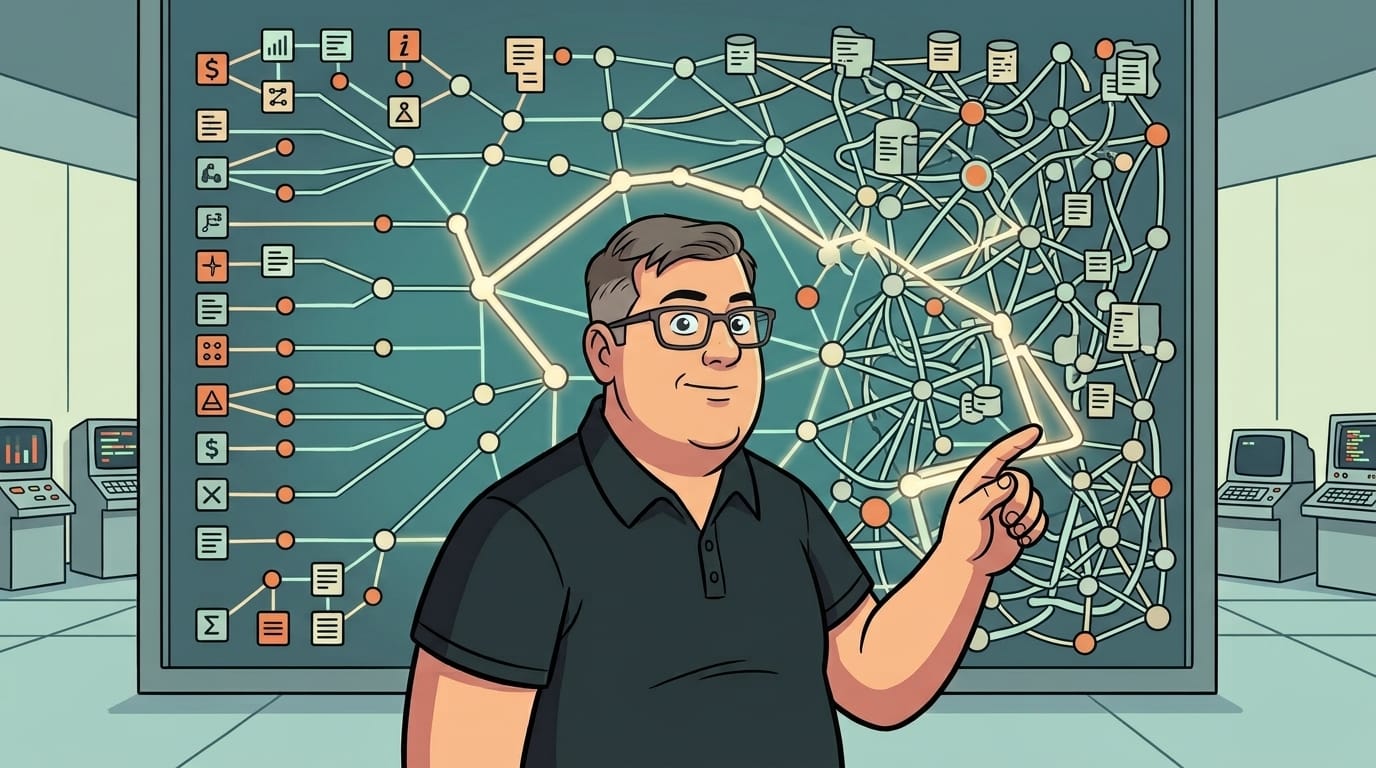
Then you have to see the world as nodes and links. That's systems thinking, and it's not optional.
Systems thinking gives you the vocabulary to separate opportunity from constraint, to spot patterns instead of incidents, and to reason about whole-part relationships; which is to say, everything. It hands you the methodology to take a complex environment apart and decompose it into pieces small enough to actually work.
Decomposition is the whole game. A problem you can't decompose is a problem you can't measure, and a problem you can't measure is a problem you can only guess at. The practitioners running hundreds of experiments a day aren't smarter. They've just broken the work down until each piece is small enough to test.
Run the Method
Now apply the thing you learned in grade school. The scientific method is the most underrated way of thinking in this era.
Once you understand the domain and can scope a problem tightly, the sequence is simple. What does the current environment look like? What is the new environment supposed to look like? What is the smallest change I can make to see its effect? And how do I control for the rest of the system so I can actually attribute the result to that change?
It isn't rocket science. It's the stuff rocket science is built on. It's the rigor underneath every major achievement, AI included. And the last step is the one people skip: to measure a change, you have to know precisely what changed. Design the experiment before you run it, or you'll be left holding an interesting result you can't explain.
Let the Answer Breed Questions
Reaching the end of an experiment should leave you with more questions than you started with. That's not failure. That's the signal the loop is working.
Those new questions should pull you toward the next investigation. Whether you follow them immediately depends on where you are; there's a genuine tension here. Business solution delivery is applied and time-boxed. Research is open-ended and patient. This new world straddles both, because it moves fast enough that yesterday's applied solution is today's research question. Know which side of that line you're standing on before you decide how far down the rabbit hole to go.
The Sum Is Taste
Stack these together and what you get is taste. Judgment about the right ordinal direction; not the perfect answer, but the better next step. Domain knowledge to sense whether you're actually solving the problem or just moving it. Enough scar tissue to know your window for asking meaningful questions is narrow, and to spend it well.
Taste is what separates the practitioner who runs a hundred experiments and learns nothing from the one who runs ten and reshapes the roadmap.
This is what it means to be rigorously curious. Interested in the detail. Disciplined in the research. Committed to turning the output into an outcome.
The tools are the same for everyone. What you do with the questions is not.