
If you don't know what Markdown is, you might be in the same position as someone 40 years ago who was still struggling to figure out what this WordPerfect thing was and how it was better than the IBM Selectric.
To draw that story out a bit more: VisiCalc was one of the killer apps that drove PC sales. There have been tons of podcasts about it, and the history of it is fascinating. That's because the world of accounting was incredibly labor intensive. Paper ledgers, old-school calculators, and hours pouring over pages and pages was the typical day. When the modern PC showed a better way to do that, the people who had the money, CFOs and their teams, said "shut up and take my money!" It was possible to have years of ledgers on a single system that at the end of the day could be safely locked away in an office.
Another lesser known story is how organizations who mostly dealt in words had a similar transformation, driven primarily by a word processing software called WordPerfect. Ask any lawyer who worked during the 80s what they used, and nearly every one will answer WordPerfect. And it wasn't just those in the legal field, similar word processing stories drove transformation in areas where words mattered: government and peripheral organizations rapidly adopted technology to produce more words, quickly.
And now we're seeing a similar cycle as AI tools, and specifically generative AI, have settled on a simplified text formatting called markdown to drive human-to-machine interactions. And this is why I think markdown will eventually replace the complex text formats we've architected over the past thirty years and eventually completely replace them. There is a shift from general tools exclusively for human-to-human communication to multi-model human-machine-human communication.
What's interesting is that markdown isn't a new technology. It's been around for a long time. It's the underlying technology that supports platforms like Wikipedia, and for many years it's been a staple in the software development community where speed and clarity is valued over presentation. These days, if you're writing a blog post, or a making a comment on social media, you're probably doing it in markdown. In fact, the only place where formal documents still take precedent are largely in highly regulated spaces where change tends to be much slower; government being chief among them.
But wait, you say, these older standard matter because the layout and design of a document improve readability, clarity, and professionalism. All true - and yet the most important attributes listed can be just as easily done in markdown. And where gaps exist, the simplicity of the standard will facilitate closing the gap quickly. I mean, let's just look at the underlying structure of markdown and a OOXML (the standard Word is based on) to get an understanding of just how overengineered a traditional document can be (each docx is actually an entire folder of xml documents, the comparison below is only the story itself).
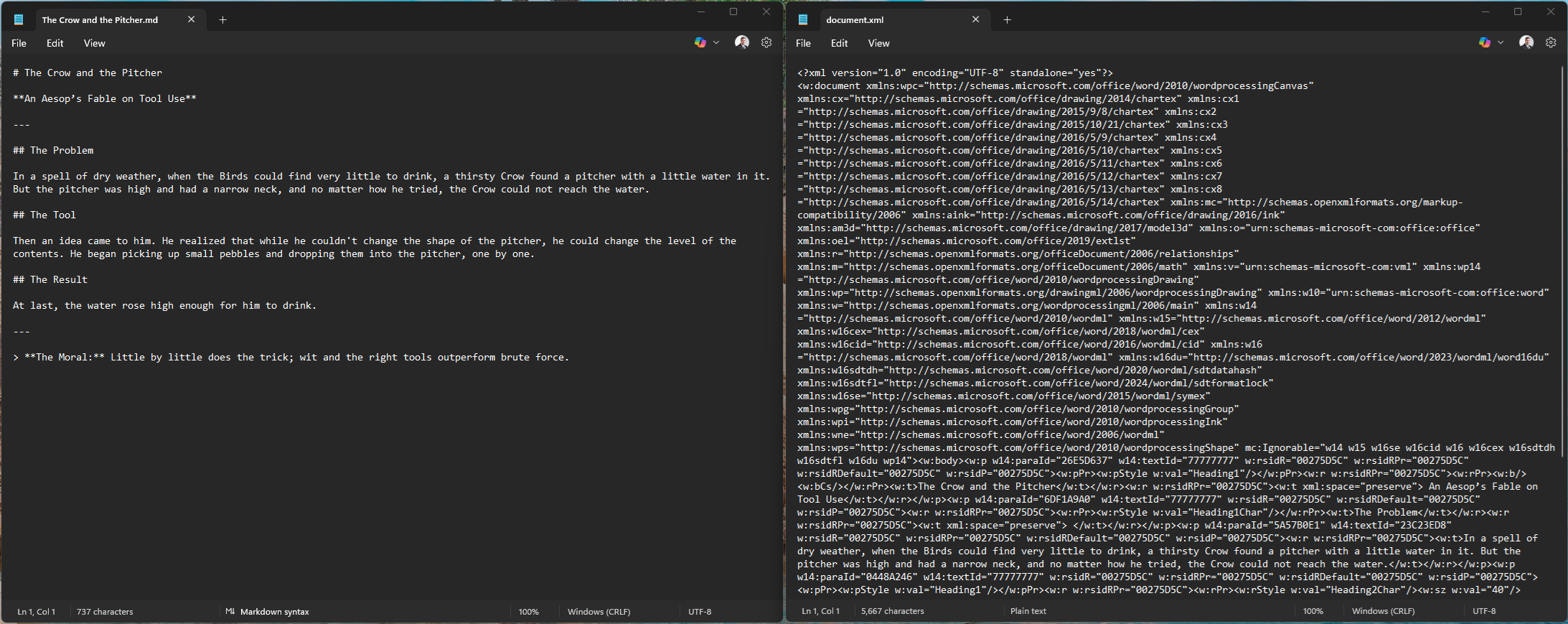
In fact, the simplicity of markdown is the primary advantage. Whereas in traditional styles, a Table of Contents is a feature to manage, in markdown is it a component of the data structure. Markdown even allows us to include directives to machines, metadata, that allows for broad acceptance and multi-technology use. The reality is that we are now in the era where Word is the new Selectric. An archaic technology designed for a printer to spit out.
So it's time for government to get on board. Markdown is the way forward, and although stand-alone creation tools are still very reminiscent of the era where WordStar, WordPerfect, and Microsoft Word all battled for supremacy, the reality is that as markdown becomes the way to communicate with the tools that do the heavy lifting, the additional emphasis will result in better tooling around the creation, editing, and design of the software. Like the transition to word processing, moving to markdown will accelerate productivity across a wide swath of tasks that depend on the exchange of words.
Need better contract management? Markdown. Better vendor management? Markdown. Better contract evaluation? Markdown (please, government, stop making word the de facto standard of submission). Better policy documents? Markdown. Position papers? Markdown. Better payments systems? That's right, markdown.
Dare I say it: need better document archival standards? Once again, markdown.
Any human-machine-human interaction should default to markdown. And the proof is right in front of us in how large language models have settled on markdown as their encoding tool of choice. So the only real question is: how hard is it going to be to get rid of your Selectric?
Here's an accelerator for your journey. Ask your nearest Tech-adjacent friend how you can create the next stand-alone document or memo in markdown. Maybe it's in MarkText, or maybe you want to pay for a great tool like Typora for that Word-like experience. Either way, write it and revel in the power that simplicity can bring, and the effortless transition markdown brings to human-machine interactions.
Stop writing for your printer. Start writing for simplicity, portability, and for other humans.