
Microsoft recently told engineers in a major division to stop using AI coding tools because the token spend exceeded what the humans would have cost. Uber burned through its entire 2026 AI tools budget in four months. Amazon is pouring $200 billion into AI infrastructure while cutting 30,000 corporate jobs.
The narrative forming around these stories is predictable: "AI is overhyped," "the economics don't work," "we told you so." But that's the wrong read. The economics don't work because the adoption model is broken. These companies pointed an expensive tool at existing dysfunction and expected magic. When it didn't materialize, they blamed the tool.
You're holding it wrong.
Remember when the iPhone 4 had antenna issues and Steve Jobs told users the problem was their grip? It was arrogant, it was wrong, and it was iconic—because sometimes the framing reveals more than the fix. Right now, enterprise AI adoption has an iPhone 4 problem. The technology works. The way organizations are gripping it does not.
Here's the thing nobody seems to want to say out loud: The playbook for building a great agentic system is the same playbook we've had for building great human teams for decades. We just refused to follow it. And now that we're trying to apply it to machines without understanding it for humans, we're burning cash at an unprecedented rate to produce the same mediocre outcomes—just faster and more expensively.
Daniel Pink published Drive in 2009. Seventeen years later, we're rediscovering his thesis—autonomy, mastery, purpose—not in a management seminar but in the system prompts of our AI agents. The irony is thick enough to cut with a knife.
The Pattern: Four Pillars, One Shape
Whether you're looking at a high-performing engineering team or a well-orchestrated multi-agent system, the profile is almost identical. Four conditions must be met. Miss one, and performance degrades. Miss two, and you've got an expensive group of individuals pretending to collaborate.
1. Set a Clear Goal (Purpose)
Pink called it "purpose." In agentic systems, we call it "the objective" or "the task." The language doesn't matter; the function does. A team—human or silicon—without a clearly articulated goal will generate activity without producing outcomes.
The failure mode is the same in both worlds. Humans without purpose default to process worship: status meetings about status meetings, documentation nobody reads, busywork dressed as productivity. Agents without a clear objective hallucinate, loop, or drift into irrelevant subtasks.
The fix is also the same: Define the outcome. Not the steps. Not the methodology. The outcome. A team that knows where it's going can figure out how to get there. A team told exactly how to walk will never learn to run.
2. Create Low-Friction Communication Flows
In agentic architectures, this is the "message bus"—structured, typed events that flow between agents without bottlenecks. In human teams, it's the meeting structure, the Slack channels, the decision logs.
Most organizations get this catastrophically wrong on the human side. They create communication overhead masquerading as alignment. Every sync, every review gate, every "quick huddle" is friction. And friction is the silent killer of velocity.
High-performing teams communicate with signal, not noise. They have conventions for what needs to be said, where it's said, and who needs to hear it. They don't over-communicate to compensate for a lack of trust—they build the trust, and the communication becomes efficient by default.
Agentic systems figured this out immediately because they had to. Token budgets force economy of language. Structured tool calls replace ambiguous natural language. The constraints of the medium demanded what human management has begged for and never received: concise, purposeful information flow.
3. Support Team Autonomy
Here's where Pink's work hits hardest. Autonomy isn't anarchy. It's the trust that a capable actor can determine how to achieve an objective once the objective is clear.
In Drive, Pink identifies four dimensions of autonomy: task, time, technique, and team. High-performing human teams have latitude across all four. They choose what to work on next, when to work on it, how to approach it, and who to collaborate with. The manager's job isn't to direct—it's to remove obstacles and set boundaries.
Now look at how we design agentic systems. We give agents a goal, a set of available tools, and constraints (guardrails, permissions, token budgets). Then we let them determine the execution path. The best agentic architectures don't micromanage the agent's steps; they define the boundaries and trust the actor.
The parallel is uncomfortable because it exposes how badly we've managed human teams. We've spent decades building org charts that look like permission systems nobody would ship in software. Approval chains six layers deep. Decision authority hoarded at the top. We build AI agents with more operational freedom than we give senior engineers.
If you wouldn't design your agent harness this way, why are you designing your team this way?
4. Own the Collective Outputs and Outcomes
This is the piece most organizations skip entirely—in both domains.
In agentic systems, we've learned the hard way that you need verification layers. Not just "did the agent produce output?" but "did the system produce the right outcome?" The orchestrator owns the collective result, not any individual agent.
High-performing human teams operate the same way. Ownership is collective. There's no "well, my part worked." The team ships or the team doesn't. The team delivers value or the team doesn't. Individual performance is a component of team performance, never a substitute for it.
This is fundamentally a leadership accountability problem. When leaders own only their individual contribution and point fingers at the rest of the system, the team fragments into a collection of optimized silos producing garbage at the interfaces. Sound familiar? It should—it's how most enterprises operate.
The agentic model forces the issue. If your orchestrator doesn't own the final outcome, the system produces incoherent results. There's no political cover. There's no "that was the other agent's fault." The system either works end-to-end or it doesn't.
The Uncomfortable Truth
We didn't need AI to teach us this. Pink told us. Deming told us. Every high-performing team in history has demonstrated these principles. We just couldn't—or wouldn't—implement them in the messy, political, ego-driven world of human organizations.
Agentic AI is forcing the conversation because the machine doesn't tolerate bad management patterns. It doesn't attend pointless meetings politely. It doesn't produce busywork to look busy. It either has clear goals, efficient communication, operational autonomy, and collective accountability—or it fails loudly and immediately.
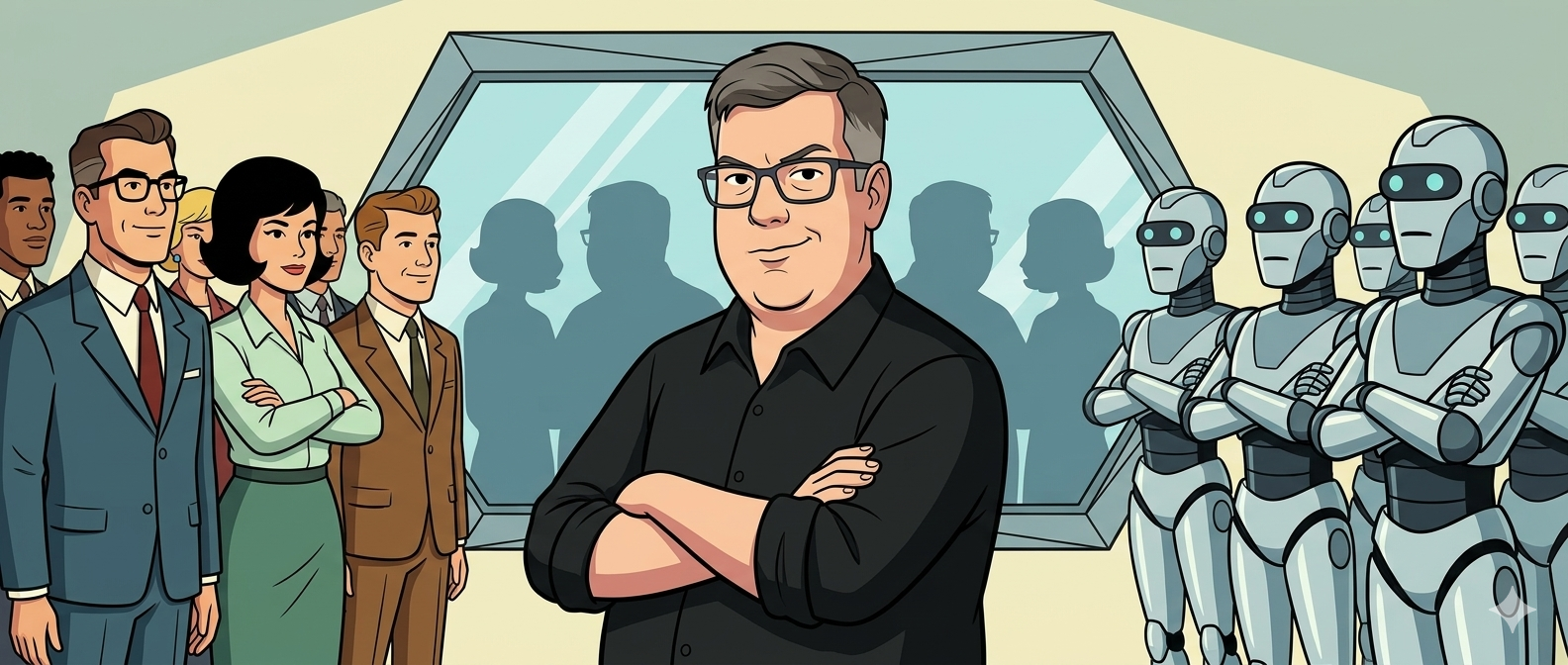
Maybe that's the real gift of this era. Not that AI replaces teams, but that building AI teams holds up a mirror to how we've been failing human ones.
The principles were always there. We just needed a system that refused to pretend bad management was acceptable.